

Mix governed rule based routing with skills prioritisation as your default, and only pilot AI assisted routing once your data and governance are genuinely ready. This combination protects first contact resolution while keeping wait times sensible, which matters more to most callers than shaving a few seconds off the queue.
TL;DR:
- Small teams should pair round robin routing with a simple time based fallback; regulated operations need centrally maintained priority rules and clear audit trails.
- Run a two to six week pilot on one low risk queue, comparing first contact resolution, average handle time, and transfer rates with baseline results.
- Keep skill profiles, CRM records, holiday calendars, and IVR menus current; stale tags or schedules can misroute calls despite otherwise functional routing.
- Track first contact resolution alongside wait and handle times; sending every call to the first available agent may shorten queues while reducing resolution quality.
- Add predictive routing only after a rule based pilot meets its targets and outcome data is clean, logged, and monitored for bias and drift.
Table of Contents
- How call routing works: components and the decision pipeline
- Common call routing strategies and how each is used
- Comparing strategies on what they optimise and where they fail
- Benefits and trade-offs: the speed versus quality decision and KPIs to watch
- How to implement or change routing: prepare, pilot, scale and govern
- AI and the future of routing: predictive, hybrid and governance considerations
- What call routing actually means, and how it differs from forwarding or ACD
- Common challenges and how to troubleshoot call routing issues
- What deployments actually teach you
- How we can help you pilot and refine your routing
- FAQ
- Sources
How call routing works: components and the decision pipeline
Call routing depends on several systems working together, not one piece of software making a single clever decision. An interactive voice response (IVR) menu captures what the caller wants, an automatic call distributor (ACD) queues and assigns the call, and a CRM enriches it with account history, value tier or recent interactions so the system has context before a human ever answers.
Most mature setups follow a predictable decision pipeline, described in intelligent call routing research as a six step process:
- Identify the caller through number, account lookup or IVR input.
- Enrich the session with CRM and history data.
- Detect intent from menu choices, speech or typed input.
- Score candidate agents or queues against skill, availability and priority rules.
- Execute the routing decision and connect the call.
- Log the outcome for reporting and future tuning.
Each step introduces its own constraints. Enrichment calls add latency if your CRM lookup is slow, and that lag is noticeable to callers once it passes a second or two. Recording and consent settings also shape design choices: in New Zealand business settings, recording is permitted when a participant is involved, but best practice is to notify callers and control retention, which means payment related calls or sensitive queues often need a different recording and routing path than general enquiries. Workforce management (WFM) and workforce engagement (WEM) data, such as rostered skills and real time availability, feed the scoring step so the system does not route to an agent who is technically logged in but on a break.
Common call routing strategies and how each is used
Most contact centres combine two or three of the following approaches rather than relying on one.
- Skill based routing matches callers to agents with the right expertise, product knowledge or language, which is the single biggest lever for first contact resolution.
- Time based routing sends calls to different destinations depending on business hours, with after hours handlers, voicemail or an answering service picking up outside the roster.
- Geographic routing directs callers to the nearest branch or regional team, useful when local knowledge, time zones or language variation matter.
- Round robin, least recent and most idle routing spread volume evenly across a team, which protects fairness and prevents burnout on your busiest agents.
- IVR and data directed routing use menu selections, account status or CRM flags, such as a flagged complaint or an overdue invoice, to send the call down a specific path before an agent is involved.
- Priority, SLA and VIP routing push high value or contractually bound callers to the front of the queue, often at the cost of average wait time for everyone else.
- Overflow and callback routing catch calls that would otherwise breach wait thresholds, either diverting them to a secondary queue or offering a scheduled callback instead of holding.
Time based and overflow routing work well together: a sensible after hours fallback is only useful if your daytime overflow rules are also tight enough that calls rarely spill into the after hours path by accident. For teams handling missed calls outside business hours, a compliant missed call recovery approach keeps that handoff tidy rather than leaving callers in limbo.
Pro Tip: Review your IVR menu every quarter. Menus drift as products and teams change, and a stale option list quietly misroutes calls for months before anyone notices.
Comparing strategies on what they optimise and where they fail
No single strategy wins on every dimension, so the right pick depends on what you are trying to protect: speed, resolution quality, fairness or compliance.
- Skill based routing is best for mixed skill teams, optimises for resolution over raw speed, carries moderate complexity, needs accurate skill tagging and recent performance data, and tends to fail when skill profiles go stale.
- Time based routing is best for businesses with defined hours, optimises for coverage and continuity, is low complexity, needs only a schedule and fallback destination, and fails when holiday calendars are not maintained.
- Round robin and most idle routing are best for small, evenly skilled teams, optimise for fairness and workload balance, are low complexity, need real time presence data, and fail when agent skill levels are actually uneven.
- IVR and data directed routing are best for high volume centres with rich account data, optimise for both speed and relevance, carry higher complexity, need clean CRM integration, and fail when menus grow too deep or data is incomplete.
- Priority and SLA routing are best for contracts with service guarantees or regulated obligations, optimise for compliance and retention of key accounts, are moderate complexity, need tiering rules maintained centrally, and fail when too many callers are tagged priority, which defeats the purpose.
Small teams generally do well on round robin plus a simple time based fallback. Regulated or contractual contexts need priority and SLA routing with clear audit trails. High volume centres get the most value from combining skill based and data directed routing, provided the underlying data is trustworthy.
Benefits and trade-offs: the speed versus quality decision and KPIs to watch
Well designed routing lowers average wait, lifts first contact resolution (FCR), cuts repeat transfers and improves agent productivity because fewer calls bounce between teams. But these gains are not free of trade-offs.
Academic threshold routing research shows that policies balancing wait time against resolution probability, such as the pµ rule and RPT (reduced pool threshold) controls, consistently find that cutting wait time too aggressively lowers resolution quality, reflecting the trade-off between speed and quality in routing decisions, according to research on threshold routing policies.pdf). In practice, routing every call to whichever agent is free first often answers faster but resolves less, while holding a caller slightly longer for the right specialist tends to close the matter in one contact.
For a pilot, track:
- First contact resolution, the clearest signal that routing logic is matching callers correctly.
- Average handle time (AHT), watched alongside FCR so you are not just making calls shorter and less useful.
- Transfer rate, which should fall as skill matching improves.
- Abandonment rate and CSAT, which catch problems the other metrics miss.
How to implement or change routing: prepare, pilot, scale and govern
Changing routing logic without a staged plan is how teams end up “routing by accident”, relying on default queues instead of a design built around customer journeys, according to practitioner guidance on intelligent routing rollouts.
- Prepare by cleaning CRM records, mapping the common customer journeys through your IVR, and defining success metrics and governance boundaries before changing anything live.
- Pilot on a single, low risk queue. Record baseline FCR, AHT and transfer rates, then run a time boxed proof of concept, typically two to six weeks, before touching other queues.
- Scale only after the pilot clears its targets. Integrate WFM, quality assurance and recording systems, schedule regular audits, and keep a documented rollback procedure in case a change underperforms.
- Govern on an ongoing basis: review integration points, check latency at each enrichment step, confirm recording consent settings match the queue’s content, and keep a fallback IVR path ready if routing logic fails.
Pro Tip: Never remove the old routing configuration until the new one has run clean for a full billing cycle. A fast rollback beats a slow investigation during a live outage.
If you are planning a pilot, a two week cloud PBX migration pilot and audit is a reasonable template for scope and timing, and teams setting up or revising IVR flows can use copyable auto attendant scripts to shortcut the build. For teams that also manage inbound leads from marketing campaigns, a practical guide to automating lead routing is a useful reference for connecting website enquiries into the same pipeline as phone calls.
AI and the future of routing: predictive, hybrid and governance considerations
Predictive routing goes beyond fixed skill tags: it scores agents against intent, sentiment and historical outcomes to pick the best match for that specific caller, not just the next available person with the right label, according to NiCE’s description of AI powered routing. The strongest setups are hybrid: rules handle non negotiables like compliance and VIP handling, while the AI layer optimises everything else.
That only works with the right groundwork in place:
- Clean, logged outcome data, since models trained on messy history inherit the mess.
- A feedback loop that measures FCR, handle time and sentiment shifts, then retrains the model.
- Regular checks for bias and drift, so the model does not quietly favour certain agents or caller groups.
The practical threshold for adding AI is simple: only after your rule based pilot has hit its targets and your data is clean enough to trust. For teams at that stage, deploying AI routing without replacing existing systems is worth reviewing before committing to a full rebuild.
What call routing actually means, and how it differs from forwarding or ACD
Call routing is the set of rules and logic that decides which queue, team or agent receives an incoming call, based on signals like caller input, account data, time of day or skill requirements. It is a decision process, not a single feature.
Call forwarding is different and much simpler: it redirects a call from one number to another, usually with no logic beyond “if unanswered, send here.” There is no scoring, no enrichment and no choice between multiple candidates.
An ACD is the piece of infrastructure that actually queues calls and connects them to agents once a routing decision has been made. Routing strategy decides who should get the call; the ACD carries out that decision and manages the queue while it waits. Confusing the two is common, and it matters operationally: a business can have a perfectly functional ACD and still have poor outcomes because the routing logic feeding it is thin, outdated or inconsistent with how the business actually operates today.
Common challenges and how to troubleshoot call routing issues
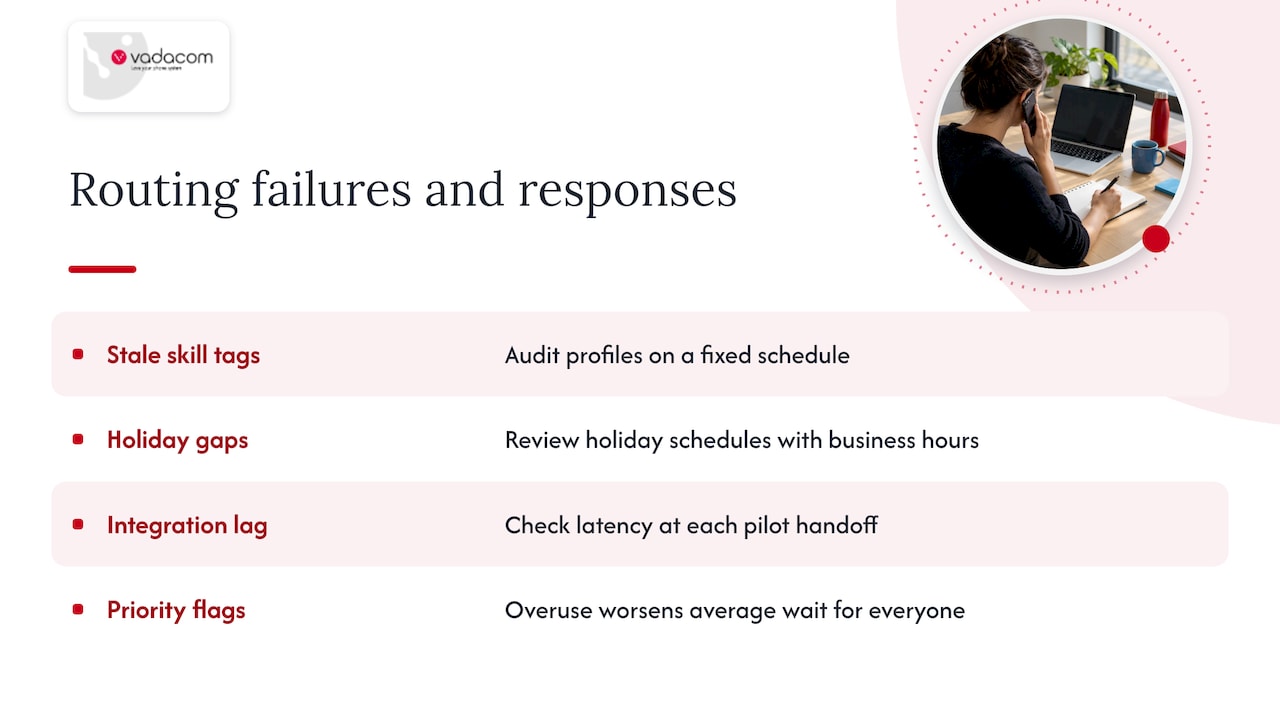
Most routing problems trace back to one of a handful of causes. Stale skill tags are the most frequent: agents change roles, pick up new product knowledge or move teams, and if the routing system is not updated, calls keep going to the wrong desk long after the mismatch starts. Audit skill profiles on a fixed schedule rather than waiting for complaints to surface the gap.
Holiday and after hours gaps are another common failure. A routing configuration that works perfectly on a normal Tuesday can misfire completely on a public holiday if the calendar was not updated, sending calls to an empty queue instead of the intended fallback. Build holiday schedules into the same governance review as regular business hours.
Integration lag between the IVR, ACD and CRM shows up as callers repeating information they already gave, or as misrouted calls when enrichment data arrives too late to influence the decision. Checking latency at each handoff point during a pilot catches this before it reaches full volume.
Finally, over tagging priority or VIP status defeats its own purpose. If too many callers carry a priority flag, the queue simply reshuffles rather than genuinely protecting the callers who need it, and average wait worsens for everyone without the trade-off paying off.
What deployments actually teach you
Every rollout we have seen succeed started smaller than the team wanted. Governance felt like friction at first, then became the reason the pilot survived its first bad week. Data hygiene is the unglamorous work nobody wants to budget for, and it is also the single biggest predictor of whether skill based or predictive routing performs as promised.
Individual call flow management and AI Call Intelligence exist precisely because routing decisions and the insight behind them need to sit in the same place, not in separate tools that drift out of sync.
— Stuart
How we can help you pilot and refine your routing
We build NextVoice around the same principle this guide follows: governed call flow management first, with optional AI Call Intelligence once you are ready to go further. Our team can run a technical audit of your current setup and help you scope a low risk pilot before you commit to a bigger change. Start with our technical audit to see where your current routing stands.
FAQ
What does “call routing” mean?
Call routing is the logic that decides which queue, team or agent an incoming call should reach, based on signals such as caller input, account history, time of day or required skill. It sits above the ACD, which carries out the connection once the routing decision is made.
What are some effective strategies for building a successful call centre?
Effective call centres combine clean data, clear governance and a staged rollout, starting with a time boxed pilot on one queue before scaling changes. Pairing skill based routing with sensible overflow and after hours handling tends to protect both resolution and wait times, according to practitioner guidance on staged routing rollouts.
What are the types of calls a routing system needs to handle?
A routing system typically handles general enquiries, account specific calls tied to CRM data, priority or SLA bound calls, and after hours or overflow calls that need a fallback path. Each type often needs its own routing logic rather than one generic rule set.
How do I know if a call was outgoing or incoming?
Call logs in your phone system or CRM record the direction of each call alongside the number, timestamp and duration. Most ACD and reporting dashboards label this clearly as inbound or outbound without extra configuration.
Can routing be tracked to measure marketing or sales performance?
Yes, call tracking ties inbound numbers to specific campaigns or pages, letting teams measure which sources generate calls worth routing to sales versus support. A practical overview of call tracking for performance measurement is a useful starting point for setting this up alongside your routing KPIs.
Sources
- AI-Powered Routing in Contact Centers | NiCE
- Intelligent call routing: The tech behind faster, smarter call centres | TechRepublic
- Is it legal to record conversations in New Zealand? | Sprintlaw NZ