
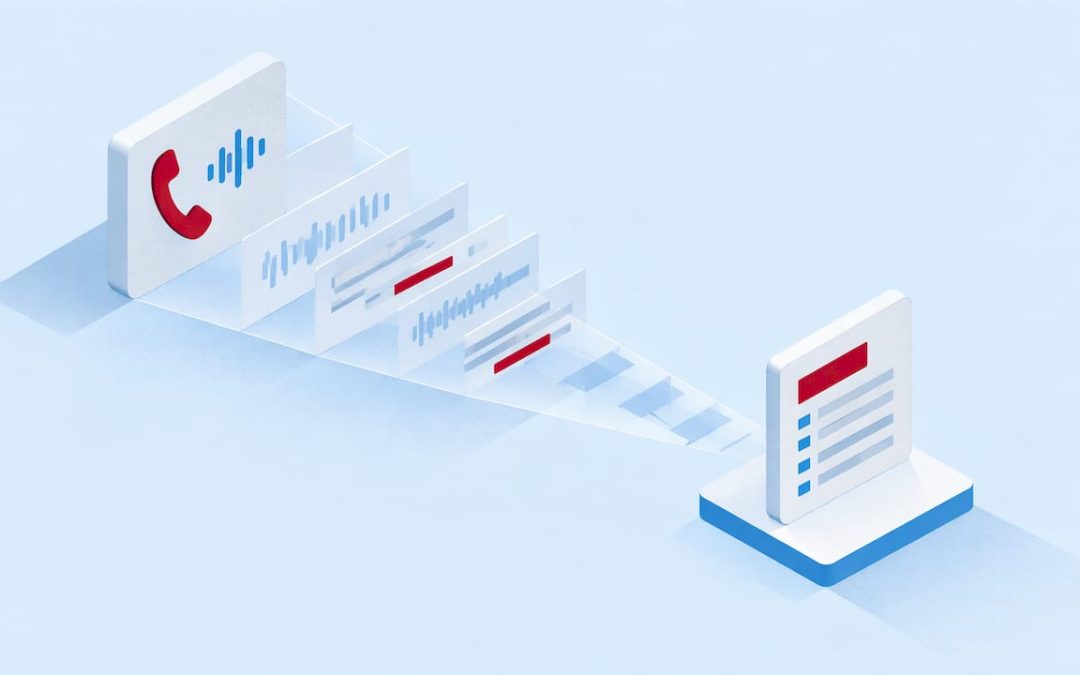
An AI call summary turns a recorded or live phone conversation into a short, structured recap: the key points, any decisions, and the next steps with owners. It replaces the notes someone would otherwise type up after the call. AI call analysis and call analytics take the same material further, looking across many calls for patterns in topics, sentiment and outcomes. This guide explains how the technology works, where it helps, how far to trust it, and what an Australian business should settle before turning it on.
TL;DR
- A summary is a structured recap of one call. Analytics looks across many calls to find patterns. Most tools do both from the same recording and transcript.
- The process is speech-to-text, speaker identification, language understanding, then a written recap. Poor audio at the start leads to weaker summaries at the end.
- Research shows AI summaries can be complete and low in errors, but they still miss details such as names and payment amounts. Keep a human check on anything that carries money, legal weight or a customer commitment.
- Before you start, settle recording consent, where recordings and transcripts are stored, who can read them and how long you keep them.
- Start with one team and one clear goal, then widen the rollout once the summaries prove useful.
Table of Contents
- What an AI call summary is, and what it is not
- How the technology turns a call into a recap
- What you get out of it
- How accurate are AI call summaries?
- Privacy, consent and data security
- What to check before you switch it on
- Perspective: summaries are only as good as the phone system underneath
- Where Vadacom fits
- Choosing between summaries, analytics and an AI receptionist
- FAQ
- Sources
What an AI call summary is, and what it is not
A transcript records everything that was said. A summary decides what mattered. Slack’s guide to AI call summaries describes the output as a recap with key points, decisions and next steps. It typically identifies speakers, groups topics and pulls out action items with owners and follow-ups.
The three phrases people search for overlap, but they are not the same thing:
| Term | What it covers | Typical question it answers |
|---|---|---|
| AI call summary | A recap of one call: key points, outcome, next steps | “What did we agree with this customer?” |
| AI call analysis | A closer reading of a call: topics, intent, sentiment, how the conversation went | “Why was this customer unhappy?” |
| AI call analytics | Call data extracted and compared across many calls | “What are customers calling about most this month?” |
One description of AI call analytics is the automatic extraction of transcript, summary, sentiment and topics, so a team can look for patterns across hundreds of calls rather than replaying individual recordings. Summaries are the part most staff see every day. Analytics is the part managers use to improve the operation.
How the technology turns a call into a recap
The steps are consistent across most products, even when the names differ.
- Capture the audio. The call is recorded by the phone system, or the audio is passed to the AI service live.
- Transcribe it. Automatic speech recognition converts the audio to text.
- Work out who said what. Slack’s guide calls this diarization: separating the speakers, such as your agent and the caller.
- Interpret the meaning. Natural language understanding picks out intent, topics and how they relate.
- Write the recap. The output is structured as a summary that combines extractive and abstractive approaches. Extractive pulls key phrases directly. Abstractive rewrites them in new words.
- Send it where it is useful. HubSpot’s guide, as captured in the research, adds further steps: extracting action items, syncing to a CRM and reporting on trends over time.
Cloud providers describe the same stack. AWS documentation states that Amazon Transcribe Call Analytics combines speech-to-text models, large language models and task-specific language models trained on customer service and sales calls. It reports measures such as sentiment, call drivers, non-talk time, interruptions and talk speed. Those last measures show that analytics is not only about the words. It also covers how the conversation flowed.
The practical lesson: a summary is only as good as the recording underneath it. Clear audio, a good headset and a stable connection do more for summary quality than any setting in the AI tool.
What you get out of it
The value shows up in a handful of places.
Less after-call admin
Every call used to end with someone typing notes, or not typing them. A summary posted to the customer record or sent to the account owner removes that step. It also makes the record consistent, because every call gets the same structure instead of whatever the person on shift had time for.
Better handovers
When a call is transferred or a colleague picks up a thread, the recap tells them where things stand. This matters most for small teams where one person covers for another, and for remote teams where nobody can lean over and ask. If your phone system already supports announced transfer and extension dialling, a summary is a useful second layer: the person you transferred to hears the context, and the written recap confirms it.
Visible customer themes
Across a month of calls, analytics can show the questions that come up repeatedly, the products that cause confusion, and the times of day when callers wait longest. That is evidence you can use to fix a web page, change a call flow or rewrite a script. If you want to act on those patterns, mapping your calls before you build is the natural next step, because the changes usually belong in how calls are routed.
Coaching based on real calls
Managers can’t listen to every call. Summaries and sentiment flags help them choose which calls are worth listening to in full. That is a better use of coaching time than sampling at random.
A searchable knowledge base
Summaries of resolved calls contain the answers your team gave. Feeding the useful ones into a shared knowledge base means the next person doesn’t start from zero. Building an AI knowledge base for support teams covers how to structure that material so it can be searched later.
How accurate are AI call summaries?
Accurate enough to be useful, but not accurate enough to go unread when the stakes are high.
Oscar Health, a US health insurer, compared AI-written summaries with those written by its own Care Guides in a 2024 study. The AI summaries had 8.24% fewer errors across four categories and did not contain hallucinations. They were more complete but less accurate than the human versions. Where accuracy slipped, the cause was usually the source transcript: Spanish speakers were transcribed less well, names were mispronounced, and details such as payment amounts were missed.
A 2025 academic paper presented at EMNLP, an industry study of call summarisation, tested 20 large language models on 2,500 real call transcripts. It found systematic “operational biases” in every model, regardless of size or family. The models tended to over-attend to some parts of a call and under-attend to others. Targeted prompting measurably reduced the bias in nine of the models.
What this means in practice:
- Accents and names are the weak point. Australian businesses take calls from a wide mix of accents, and from people spelling out street names and surnames. Expect errors there.
- Numbers need a second look. Amounts, dates, phone numbers and reference codes are the details most likely to cause trouble if they are wrong.
- Configuration matters. The research suggests that how the summary is requested affects what it emphasises. Tell the tool what your business cares about, such as the commitment made, the product discussed and the follow-up date.
- Review where it counts. A summary of a routine enquiry can be trusted to save time. A summary that records a quote, a complaint outcome or a contract change should be checked by a person before anyone acts on it.
No tool can promise a perfect recap, and none of these results should be read as a guarantee for your own calls. The sensible approach is to measure quality on your own recordings during a pilot.
Privacy, consent and data security
This is the part many businesses skip, and it is where the real risk sits. Three questions come first.
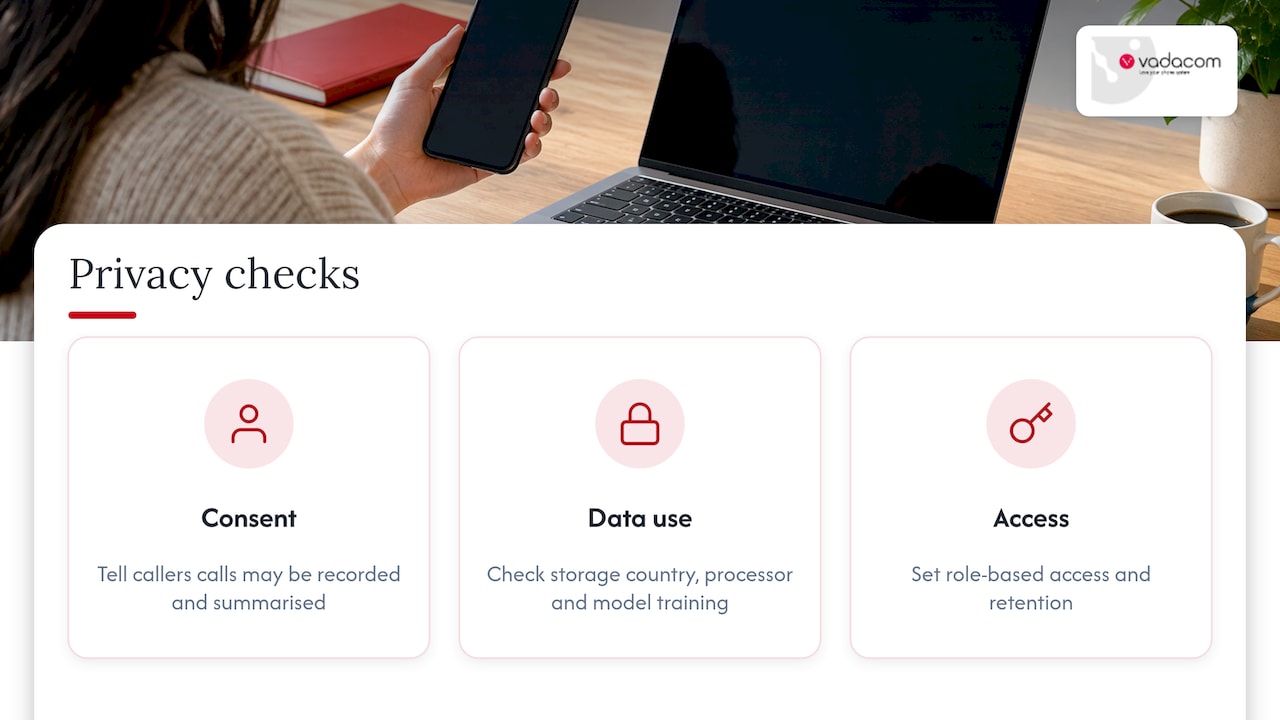
Do callers know they are being recorded and analysed? Recording a call is the starting point for any summary. In Australia, rules on recording differ between federal law and the states and territories, and they depend on whether the parties are told. Telling every caller at the start of the call, usually through a short recorded message, is the standard approach. Because the position varies by jurisdiction, confirm your obligations with a lawyer or the relevant regulator before you record. Our guide to call recording for small businesses covers consent and retention in more detail.
Where do recordings and transcripts live? A summary is a copy of personal information in a new form, and so is the transcript behind it. Know which country the data is stored in, who the processor is, and whether the vendor uses your calls to train its models. Where call recordings are stored and how to manage them is worth reading before you pick a tool.
Who can read the summaries? A summary of a sales call is not meant for the whole company. Summaries of calls with customers about health, finances or complaints can contain sensitive details. Set access by role, and decide how long you keep them. If you hold personal information, the Privacy Act and the Australian Privacy Principles apply to how you collect, use, store and secure it, so involve whoever looks after privacy in your business, and the Office of the Australian Information Commissioner’s guidance is the place to check current expectations.
Two habits keep you out of trouble. First, tell customers in plain words that calls may be recorded and summarised by software. Second, treat the AI output as a business record, with the same retention and deletion rules as the recording.
What to check before you switch it on
A short checklist, in the order that saves the most pain.
- Name the job. “Save five minutes of notes per call” and “spot repeat complaints” need different set-ups. Pick one first.
- Check your audio. Listen to a handful of recordings. If you can’t understand them, neither can the software.
- Confirm consent wording. Update your recorded greeting and your privacy policy before the first summary is generated.
- Decide where summaries go. Into the CRM, a ticket, an email to the account owner or a shared channel. A summary nobody sees saves nobody any time.
- Set access and retention. Who reads them, and when they are deleted.
- Check the integration with your phone system. Summaries rely on recordings, so the AI layer has to sit comfortably with the platform that carries your calls. If your phone system is an ageing on-premise one, that may be the first thing to sort.
- Pilot with one team for a few weeks. Compare a sample of summaries against the recordings and write down the error types you find.
- Train people to use it as a draft. Staff should know when to correct a summary, and how.
The last two matter most. Our view on why AI should wait for a governed pilot applies to summaries as much as to routing: start small, measure, then expand.
Perspective: summaries are only as good as the phone system underneath
We see AI call summaries as the visible end of a longer chain. Before an AI can summarise a call, the call has to be answered, routed, recorded and stored properly. When those basics are wrong, the summary inherits every problem.
That is why we build NextVoice around the essentials: extension dialling, call transfer and announced transfer, voicemail, in-app recording and individual call-flow management. It runs on a telco-grade cloud architecture across multiple availability zones, so teams in the office, at home or on the road reach each other the same way. Once calls are captured reliably, optional AI Call Intelligence can add insight from recording and analysis for customers who want it.
Our advice to New Zealand and Australian businesses is to keep it practical. Choose the one outcome you want, such as faster follow-up or a clearer picture of why customers call. Make sure callers are told about recording. Keep a person in the loop for anything involving money or commitments. Then grow from there. We have spent more than 20 years designing, delivering and supporting communications locally, and we would rather help you get the foundation right than sell you a feature you cannot use yet.
Stuart
Where Vadacom fits
If you want call summaries and insight without replacing your whole phone setup, our AI Call Intelligence offering is designed to add analysis on top of call recording. It is built for customers who want deeper insight from their calls, and we support it locally in New Zealand and Australia. Pricing is not published, so talk to us about your team size and goals.
The platform underneath is NextVoice, our cloud business phone system, with in-app recording, call flows and self-service administration. If you are still running an older on-premise system, our technical audit is a sensible first step. For businesses that mainly want calls answered when nobody is free, there is also our AI answering service.
Choosing between summaries, analytics and an AI receptionist
These tools solve different problems, and the choice is clearer when you start from the problem.
- You lose time writing up calls. Start with call summaries.
- You don’t know why customers call or where they get stuck. Start with analytics across calls, then change your call flows.
- Calls go unanswered at busy times or after hours. An AI receptionist or auto attendant addresses that before anything is recorded. Our guides on the AI auto attendant and after-hours phone answering explain how they work.
- You are comparing voice agents more broadly. This overview of how to compare AI phone agents sets out the criteria to weigh.
Many businesses end up using more than one. The order matters. Answering and routing come first, because a call that is never answered never gets summarised.
FAQ
What is the difference between a call transcript and an AI call summary?
A transcript is a word-for-word text record of the call. A summary condenses it into key points, decisions and next steps, usually with action items and owners. Most tools produce both, so you can check the summary against the transcript when something looks off.
Can AI summarise calls in real time?
Some tools generate notes during the call, while others produce the summary shortly after it ends. The underlying steps are the same: speech-to-text, speaker identification, then a written recap. Ask any provider which approach they use and how quickly summaries reach your team.
Do I need to tell callers their call is being summarised by AI?
You should tell callers that the call is being recorded, and it is good practice to mention that software may analyse it. Recording rules differ across Australian jurisdictions, so confirm your wording with a lawyer or the relevant regulator. Keep the same wording in your privacy policy.
How accurate are AI call summaries?
Research shows they can be complete and low in errors, but they still miss names, accents and details such as payment amounts. A US health insurer study traced most problems to poor transcripts. Review summaries that involve money, commitments or complaints before anyone acts on them.
Will AI call summaries suit a small business?
They can, particularly where a few people handle all the calls and notes get skipped. Begin with one team and one goal, such as faster follow-up, and check a sample of summaries against the recordings. We can talk through whether it suits your set-up and size.
Sources
- AI Call Summary: How Teams Turn Talk Into Action | Slack
- AI Call Analytics: Sales Calls as Data Source + MCP
- Call Summarization: Comparing AI and Human Work | Oscar Health
- Spot the BlindSpots: Systematic Identification and Mitigation of Operational Bias in LLM Call Summarization | EMNLP 2025
- Build an AI Knowledge Base for Support Teams
- The Best AI Phone Agents in 2026: How to Compare Them