

The simplest way to stop losing after hours callers is a professionally staffed, cloud hosted after hours phone answering service, with AI augmentation added where call volume or budget demands it. This suits any business that can’t afford a missed lead, needs fast dispatch for urgent jobs, or wants bookings taken while the office is closed. The next move is straightforward: book a demo or request a soft launch trial and see live coverage running within days, not months.
TL;DR:
- Call volume outside standard hours often justifies investing in a hybrid AI and human answering service to increase lead capture and improve customer response times.
- Effective services personalize greetings and intake questions, with rapid escalation routines within about one minute for urgent calls like burst pipes or locked-out tenants.
- Pricing varies based on coverage hours, call volume, and added features, with transparent providers offering detailed estimates tailored to your business needs.
- Most providers can activate the service within one to seven business days, with a soft launch and testing phase to ensure scripts and escalation paths function correctly.
- Local support combined with scalable cloud infrastructure and AI augmentation reduces operational risks and offers quick, customized setup for small and medium businesses.
Table of Contents
- What does after hours phone answering actually cover?
- What features and behaviours should you expect?
- How do you choose the right after hours answering setup?
- How long does setup take and what does testing involve?
- When should you use AI, humans, or both?
- What impact does quality after hours answering actually have?
- What does after hours phone answering actually cost?
- Author perspective: why a locally supported cloud platform makes sense
- How Vadacom can help you cover the hours your office can’t
- Sources
- FAQ
What does after hours phone answering actually cover?
After hours phone answering and overflow answering solve different problems, and mixing them up leads to the wrong purchase. After hours answering picks up every call once your team clocks off, covering evenings, weekends, and public holidays, sometimes extending to near full 24/7 coverage. Overflow answering only kicks in when your own reception is busy or unreachable during business hours, acting as a safety net rather than a full-time cover.
Most New Zealand businesses need some blend of both, and the right mix depends on how many calls arrive outside 9 to 5.
A missed after hours call rarely means a caller tries again tomorrow. Voicemail conversion rates are notoriously poor because most callers hang up and ring the next business on their list instead. Live after hours call handling changes that outcome by keeping a real person, or a well configured AI answering service, on the line to capture the enquiry immediately.
What a solid after hours answering service typically delivers:
- Message capture with caller name, number, and reason for calling, logged instantly
- Appointment or job bookings taken directly into your calendar or job system
- Urgent call triage and dispatch to on call staff within minutes
- Lead qualification so your morning starts with warm enquiries, not cold voicemails
- Coverage windows tailored to your business: nights only, weekends only, public holidays, or full 24/7
Trades, medical clinics, and property managers tend to need urgent dispatch built in from day one. Retailers and professional services often get more value from simple message taking and next-day callback logging.
What features and behaviours should you expect?
A greeting that sounds like your business, not a call centre script, is the first thing callers notice. Good after hours answering service ai NZ providers let you customise the greeting, the intake questions, and the tone, so a plumbing business sounds urgent and a dental practice sounds calm.
Escalation is where the real value sits. A well built system routes urgent calls to an on call staff member fast, and industry practice among providers generally aims for escalation within about a minute or so after a call is flagged as urgent. That number matters because a burst pipe or a locked-out tenant doesn’t wait for a callback the next morning.
Notification and record keeping should give you options, not a single fixed format:
- SMS alerts the moment an urgent call comes through
- Email summaries for routine messages and bookings
- Call logs with timestamps, caller details, and outcome notes
- Recorded calls available for playback, useful for training and dispute resolution
Staffing choices matter more than most buyers expect. Some providers use offshore agents reading generic scripts, which can create a jarring mismatch for callers expecting local knowledge of suburbs, trades regulations, or common local business hours. Locally based operators and NZ-accented AI voices tend to handle these calls more naturally.
Data handling deserves a direct question in any sales call. Ask where recordings are stored, who can access them, and how long they’re retained. Cloud providers generally align with published privacy frameworks such as Google’s privacy policy as a baseline reference point for handling and storage practices, though you should always confirm your specific provider’s own policy in writing.
How do you choose the right after hours answering setup?
Picking a provider comes down to matching their capability to your call pattern, not choosing the cheapest tier on a pricing page.
- List your coverage hours precisely. Nights only, weekends, public holidays, or full 24/7, because pricing and staffing models shift significantly between these.
- Confirm the escalation rulebook exists in writing. A provider without a documented escalation SOP is guessing on your behalf during an emergency.
- Check integration options. Does the service connect to your calendar, job management software, or CRM, or does it just email you a message to type in manually?
- Ask about reporting. You want visibility on call volume, response times, and outcomes, not a black box.
- Clarify contract terms. No lock-in and transparent pricing options matter more than a flashy feature list if your call volume is seasonal.
Questions worth asking on a demo call: How fast do urgent calls reach a real person? What happens if the on call staff member doesn’t answer? Can we test the service with a soft launch before committing? Is support based locally, or do we email an offshore ticket queue?
Red flags to walk away from: no soft launch offered, pricing that’s vague until you sign, and no written escalation process. If a provider can’t answer how a 2am emergency call gets handled in the next sixty seconds, that’s your answer.
Pro Tip: Estimate your monthly cost by multiplying your average after hours call volume by the provider’s per-call or per-minute rate, then compare that against a flat monthly tier. High-volume trades businesses often save more on tiered plans; low-volume professional services usually do better on pay-per-call.
How long does setup take and what does testing involve?
Getting after hours call handling live doesn’t need to be a drawn-out project. Most providers can have a standard setup running within one to seven business days, once you’ve supplied a greeting script, intake questions, and an escalation roster.
The kickoff phase covers three things: your branded greeting, the questions callers get asked, and who gets contacted for urgent issues. Get your operations manager and whoever holds the on call phone into that conversation early.
A soft launch matters more than most businesses expect. Run simulated calls first, then move to low-volume live calls with someone monitoring quality, before handing over completely.
Before full handover, review this checklist:
- Greeting and script tested against real caller scenarios
- Escalation roster confirmed with backup contacts
- Notification channels (SMS, email) verified as working
- First batch of live calls quality-checked for tone and accuracy
Track these in month one: total calls answered, escalations triggered, bookings converted, and false-positive escalations. That last figure tells you whether your emergency criteria need tightening.
When should you use AI, humans, or both?
AI handles repetitive, structured tasks reliably: taking a name and number, asking qualifying questions, booking a slot into a calendar. Where it falls short is judgement calls, like deciding whether a vague, distressed caller genuinely needs an emergency callout right now.
Practical hybrid patterns:
- AI front-end, human escalation: AI intake handles routine calls and automatically escalates anything matching urgent keywords to a live agent or on call staff.
- Human-first for sensitive sectors: healthcare, aged care, and crisis-adjacent industries generally need a person on every call, with AI limited to after-call logging.
- Defined emergency criteria: write down exactly what counts as urgent so the system doesn’t wake your on call technician for a billing question.
AI augmentation has shown measurable productivity gains in service industries when paired with human oversight, but it needs ongoing calibration. Track escalation accuracy, the share of escalated calls that were genuine emergencies, and adjust your triage rules whenever that number drifts.
Pro Tip: *Review escalation accuracy monthly for the first three months.
What impact does quality after hours answering actually have?
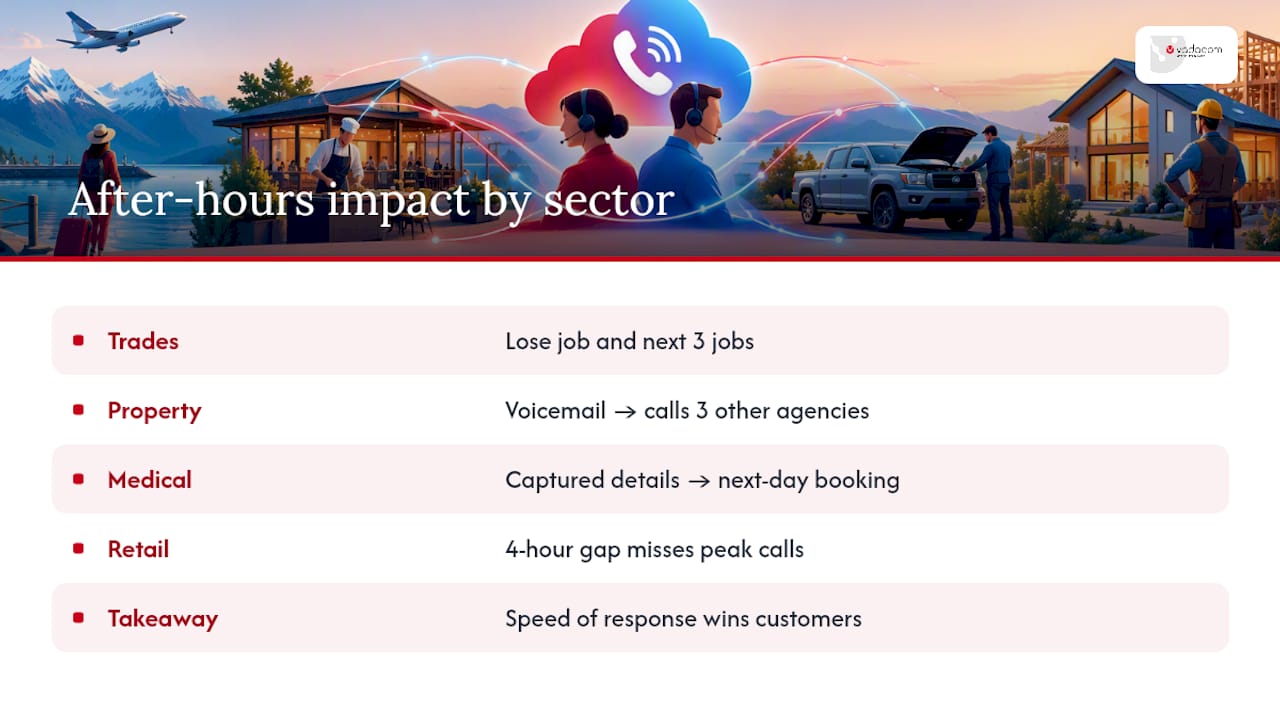
A tradesperson who misses an after hours call about a burst pipe doesn’t just lose that job. They lose the customer’s next three jobs too, because emergency callers remember whoever answered first. Property management is a clear example: a tenant locked out at 11pm who reaches a live person gets a locksmith dispatched within the hour, while a tenant who hits voicemail calls three other agencies before morning.
Medical and allied health practices see a different pattern. After hours enquiries about appointment availability or urgent script renewals often convert into next-day bookings when someone captures the details properly, rather than becoming a missed opportunity that patient takes to a competing clinic.
Retail and e-commerce businesses running national campaigns see the overflow problem most acutely. A promotion that runs until 9pm but a phone line that stops at 5pm creates a four-hour gap where every call goes unanswered, right when interest peaks. Mobile apps and CRM integrations, the kind offered by providers like Talkify, turn those after hours enquiries directly into calendar bookings or CRM records rather than a pile of unreturned voicemails.
The common thread across these examples is speed of response, not the industry. Whichever sector you’re in, the business that answers first usually wins the customer.
What does after hours phone answering actually cost?
Pricing generally follows one of three shapes: a flat monthly tier covering a set call volume, a per-call or per-minute rate, or a package bundling answering with add-ons like appointment booking or CRM integration.
Setup fees vary by provider and by how much customisation your greeting and escalation rules need. Some providers waive setup fees entirely for standard configurations and only charge for bespoke scripting or complex multi-department routing.
Watch for these common extra charges before signing anything:
- Per-minute overage fees once you exceed your plan’s included call volume
- Charges for adding extra escalation contacts beyond a base number
- Fees for call recording storage beyond a standard retention window
- Add-on charges for CRM or calendar integrations not included in the base tier
The cheapest headline price rarely reflects the real monthly cost once your actual call volume and escalation needs are factored in. Ask for a total cost estimate based on your specific coverage hours and expected call volume, not the provider’s advertised base rate. Transparent providers will walk you through this calculation before you commit to anything.
Author perspective: why a locally supported cloud platform makes sense
Legacy on-premise phone systems weren’t built for after hours flexibility, and stretching them to cover nights and weekends usually means expensive workarounds. A cloud platform built for this from the ground up, like NextVoice, sidesteps that problem entirely. Local support matters more than most buyers realise until 2am, when an offshore ticket queue simply can’t move fast enough. Pairing AI Call Intelligence with human escalation reduces the operational risk small businesses carry when a single missed call costs a customer.
— Stuart
How Vadacom can help you cover the hours your office can’t
Vadacom is the alternative to stitching together voicemail, forwarding rules, and hope. For after hours phone answering, the practical advantage is straightforward: one cloud platform built on AWS infrastructure, with local New Zealand support behind it instead of an offshore queue.
NextVoice gives your business call transfer, voicemail, and configurable call flows on a resilient platform, while optional AI Call Intelligence adds call recording and analysis for teams that want deeper insight into after hours volume and outcomes. Because it’s built on scalable AWS architecture, coverage can flex as your call volume grows without a hardware upgrade.
Onboarding is designed to move quickly, and support comes from a team that has spent over 20 years delivering communications technology across New Zealand and Australia. If you’re ready to see how a hybrid AI and human answering setup would work for your business, request a soft launch or book a demo of NextVoice and get coverage running before your next quiet weekend shift.
Sources
- AI for agencies: 3.2x ROI and real productivity gains — BabyLoveGrowth
- Talkify mobile — App Store (NZ)
FAQ
What Is an After Hours Answering Service?
An after hours answering service picks up calls outside your normal business hours, capturing messages, booking appointments, or escalating urgent calls to on call staff. It replaces voicemail with a live person or an AI system that responds immediately, so enquiries don’t sit unanswered until morning.
Do Telephone Answering Services Still Exist?
Yes, and they’ve moved well beyond the old-style call centre model. Modern after hours answering runs on cloud platforms like NextVoice, often blending AI intake with human escalation for urgent matters.
How Do I Get an 0800 Number for My Business in NZ?
A toll-free number is arranged through a New Zealand telecommunications provider, who allocates the number and routes calls to your chosen phone system or answering service. Most business phone platforms, including cloud systems, can have such a number configured as part of setup.
How Quickly Can an After Hours Answering Service Go Live?
Most providers can get a standard after hours setup running within one to seven business days, once you’ve supplied a greeting script and an escalation roster. A short soft launch with test calls typically happens before full handover to check scripts and escalation timing work as expected.
What Does After Hours Phone Answering Typically Cost?
Pricing usually follows a flat monthly tier, a per-call rate, or a bundled package with add-ons like booking integration. Vadacom’s own after hours and AI answering pricing isn’t published, so the accurate figure for your business comes from requesting a quote based on your actual call volume and coverage hours.