
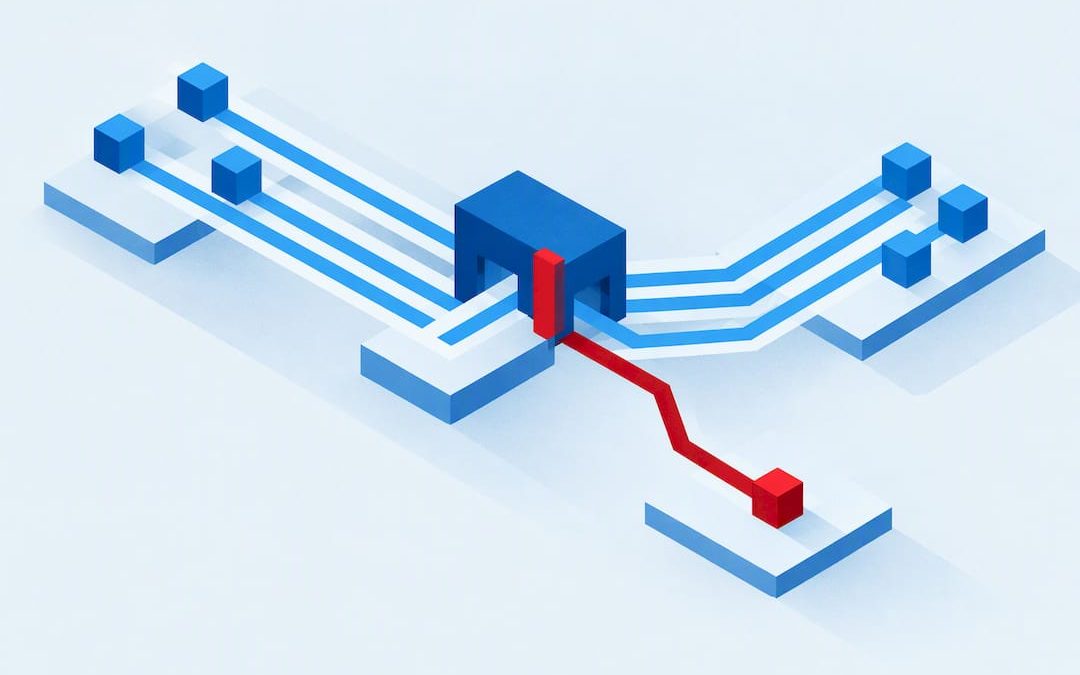
Call forwarding rules let you route incoming calls automatically: use unconditional forwarding to send every call to another number or conditional rules for busy, no answer, and unreachable situations to keep callers on your preferred path. Most people start with a conditional rule so calls only divert when they genuinely can’t be answered, then activate it through a star code or their provider’s app.
TL;DR:
- Conditional forwarding is the most common choice for businesses because it only redirects calls under specific conditions like busy or no answer, preserving normal operation.
- Call forwarding rules should be carefully ordered, with simple design checklists used to determine primary destinations, overflow targets, and schedule alignment.
- Activation methods include star codes and app or portal configuration, with codes varying by service type and destination, especially for international numbers.
- Time-based scheduling and simultaneous diversion enable flexible routing, but must be tested thoroughly to prevent misrouting or missed calls.
- Outbound call costs and scam risks are key considerations, so companies should verify forwarding settings regularly and restrict changes via secure, authenticated portals.
Table of Contents
- Building and ordering your forwarding rules
- Activation methods: codes, portals and apps
- Scheduling, exceptions and simultaneous diversion
- Advanced routing: find-me, follow-me and overflow chains
- Who pays for a forwarded call
- Spotting diversion scams and protecting your settings
- Checking, testing and cancelling a forward
- How a cloud phone platform handles forwarding rules
- What most small teams should actually run
- Vadacom NextVoice: centralised rules without the guesswork
- Sources
- FAQ
Building and ordering your forwarding rules
Unconditional forwarding sends every incoming call straight to another number, which suits someone who’s fully relocated to a different device. Conditional rules only trigger under specific conditions, busy, no answer or unreachable, and suit almost everyone else because they preserve your normal answering pattern first.
Rule order matters. Most systems apply a first-match approach, so a busy rule placed above a no-answer rule will fire before the call ever reaches the no-answer timeout. Before setting anything up, work through a short design checklist:
- Decide who answers first: an individual, an extension or a queue.
- Set the primary destination for calls that meet the trigger condition.
- Add an overflow target for when the primary destination also fails.
- Match the schedule to your actual working hours, not a generic default.
A common pattern is after-hours calls forwarding to a manager’s mobile, while a busy signal on the main line sends the caller into a team queue instead of dropping the call.
Activation methods: codes, portals and apps
Star codes are the quickest way to switch forwarding on or off directly from a handset, though the exact sequence varies by provider. A widely used pattern dials *21*[number]# for unconditional forwarding, *61*[number]# for no-answer and *67*[number]# for busy, with a matching ## cancellation code for each.
To set a rule from a portal or app instead:
- Open your provider’s app or web portal and find call forwarding settings.
- Choose the trigger (always, busy, no answer or unreachable).
- Enter the destination number in full international format.
- Save the rule, then place a test call to confirm it routes correctly.
Codes and syntax differ between mobile, landline and VoIP services from the same provider, so check your specific service type before assuming a code will work. When forwarding to an international number, use E.164 format (a plus sign, country code, then the number) so the call doesn’t fail on dialling.
Scheduling, exceptions and simultaneous diversion
Time-based rules let you route calls differently depending on the day or date, which is how most businesses handle after-hours coverage without touching settings twice a day.
- Set a weekly schedule in your portal, business hours to one destination, evenings and weekends to another.
- Use simultaneous diversion when you want more than one forwarding rule active at once, ringing several destinations rather than a single fallback.
- Add caller-specific exceptions for VIP contacts or known suppliers who should always reach a direct line.
- Build a separate holiday schedule rather than relying on your weekly default.
Test any schedule change with a real call before relying on it. Some carriers automatically test the new destination when you activate simultaneous diversion, which catches typos before a real caller does.
Advanced routing: find-me, follow-me and overflow chains
Beyond basic conditions, cloud systems support caller-ID rules that route specific contacts or contact groups differently to everyone else. Find-me/follow-me setups then decide how those calls actually ring through.
- Sequential ringing tries destinations one after another, useful when you want a strict order of who answers first.
- Simultaneous ringing rings multiple destinations at once, better when speed of answer matters more than order.
- Overflow chains send unanswered calls to a further destination, ending safely in voicemail or an announcement rather than disconnecting.
- Confirm or press-1 screening asks the receiving side to accept the call before connecting, which stops a personal mobile’s own voicemail from swallowing a forwarded call.
Pro Tip: Add confirm screening on any forward that lands on a personal mobile, otherwise a missed call can vanish into the wrong voicemail box entirely.
These triggers, always, busy, no-answer and unreachable, along with timeout settings and overflow destinations, are standard features in cloud phone control panels rather than something you need to build from scratch.
Who pays for a forwarded call
The person or business that sets up the forward generally pays for the outbound leg of that call, not the original caller.
- Forwarding to a mobile or international number can add real cost, since the forwarder pays the outbound leg at whatever rate applies to that destination.
- Premium-rate numbers as a forwarding destination can be particularly expensive and are worth avoiding altogether.
- Legacy copper-line diversions apply standard calling charges to the line owner as well, so the cost principle isn’t limited to mobile or VoIP.
Before relying on a new rule, place a short test call to the forwarded destination and check your plan’s terms for that number type. A ten-second test call is far cheaper than discovering an international forward at the end of a billing cycle.
Spotting diversion scams and protecting your settings
Call forwarding is a common target for social engineering because a scammer who redirects your calls can intercept banking codes or client enquiries without ever touching your device.
- Treat any unsolicited call asking you to dial a code or change forwarding settings as suspicious by default.
- Verify the request by calling back on a number from an official source, such as your bank’s card or website, rather than a number the caller gave you.
- Make changes through your provider’s authenticated portal rather than acting on verbal instructions over the phone.
- Report suspicious calls and block the number once you’ve confirmed it isn’t legitimate.
Official guidance recommends this callback approach specifically because it removes the scammer’s ability to control which number you actually reach.
Checking, testing and cancelling a forward
If calls seem to be going somewhere unexpected, a few quick checks confirm what’s happening.
- Call your own number from another phone and listen for a different ring pattern or an immediate divert.
- Check your provider’s app or portal for an active forwarding rule you didn’t set.
- Dial the standard cancellation code for your service, often the
##version of the activation code, to clear all forwards at once. - If the forward persists after cancelling, contact your provider directly rather than repeating codes that aren’t working.
A call landing straight in someone else’s voicemail usually means a no-answer rule triggered before you could pick up, which is exactly what confirm screening is designed to prevent.
How a cloud phone platform handles forwarding rules
The NextVoice platform manages forwarding centrally rather than through per-line codes on each handset. Rules for extension dialling, overflow and scheduling sit in one place, so a manager can see and adjust every user’s call flow without asking each person to dial a code correctly.
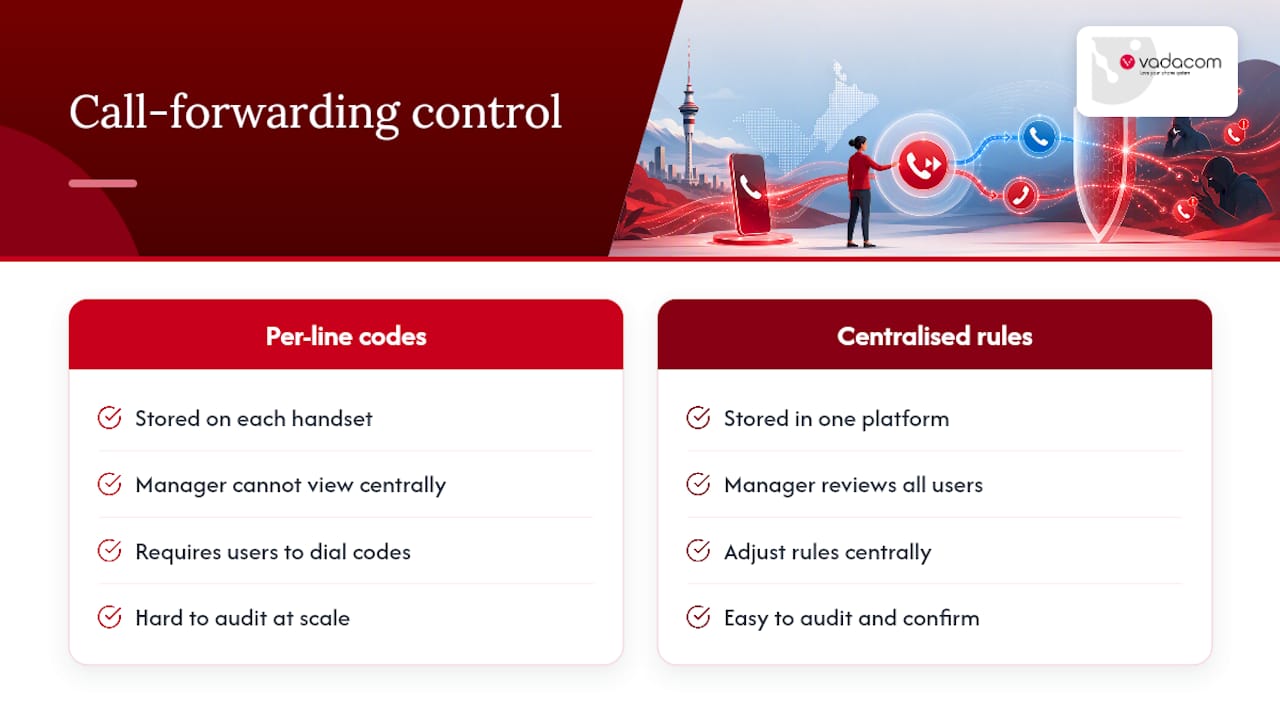
That matters most once a business has more than a handful of lines, where per-line star codes become hard to audit and easy to get wrong. Centralised rules also make it simpler to confirm that after-hours and overflow behaviour is actually set the way it’s supposed to be.
What most small teams should actually run
A simple, resilient rule set beats a clever one: business hours ring the team queue or main extension, after hours drop to voicemail or a defined on-call mobile, and busy calls escalate to a colleague rather than disappearing. Cloud-managed rules earn their keep once a single person can no longer track every line by memory.
— Stuart
Vadacom NextVoice: centralised rules without the guesswork
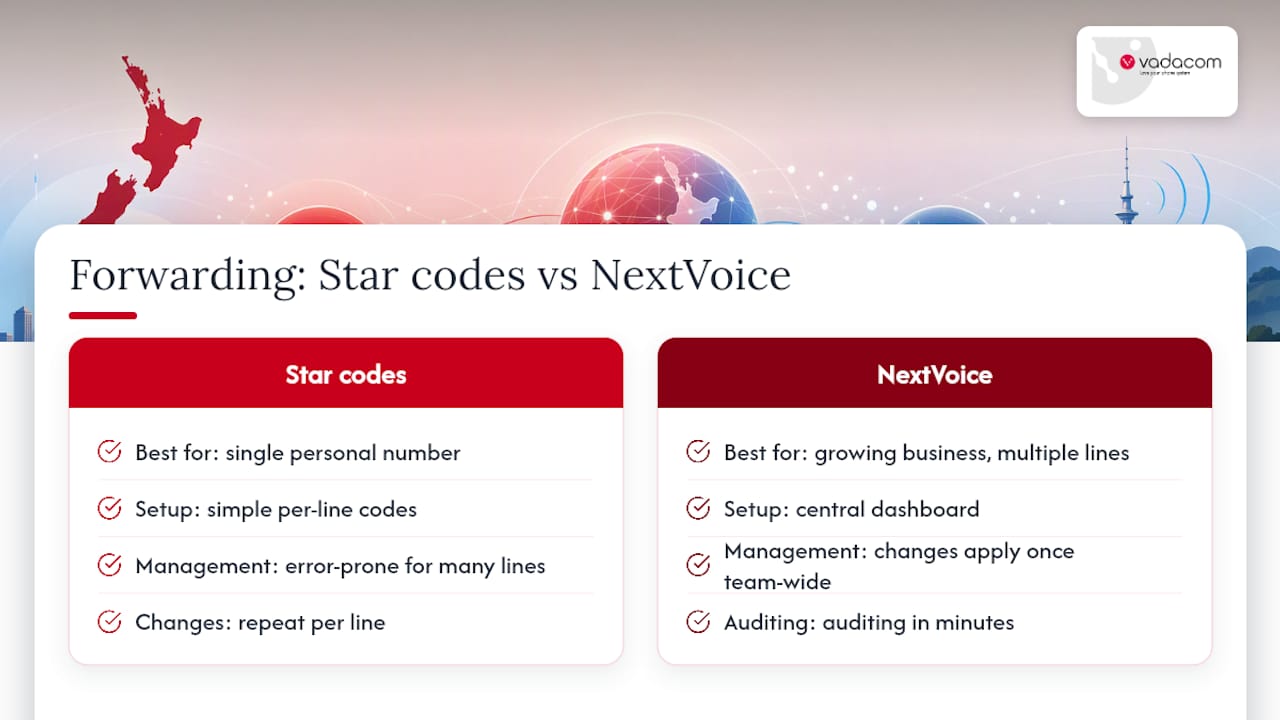
If you’re managing forwarding rules across more than one or two lines, per-line star codes get error-prone fast, and nobody notices a missed overflow rule until a customer complains. The platform puts call-flow management, scheduling and extension routing in one dashboard, so changes made once apply consistently across the team, and auditing who forwards where takes minutes rather than a round of phone calls.
For a single personal number, carrier star codes are still the simpler option, there’s no need to add a platform for one line. For a growing business, NextVoice gives you that central control, and Vadacom’s team can also run a technical audit if you’re replacing an older on-premise system with cloud-managed call flows.
Sources
For provider-specific activation steps, carrier call-divert guides show current codes and portal steps, while simultaneous diversion guidance covers multi-target forwarding. For scam protection, government scam guidance explains how to verify unexpected requests to change your settings, and general GSM forwarding standards outline codes common across networks.
- Call Divert | Setup user guides for Mobile
- Scams — New Zealand Government
- Phone calling rates — Private Box
- Sip
FAQ
How do I know if my number is being diverted by someone else?
Call your own number from another phone and listen for an unusual ring pattern or an immediate divert to voicemail or another line. You can also check your provider’s app or portal for an active forwarding rule you didn’t set yourself.
What’s the code to turn off call forwarding?
Cancellation codes typically mirror the activation code with a ## prefix, for example the code that turns off an unconditional forward that was set with *21*. Exact codes vary by provider and service type, so check your carrier’s own instructions if the standard pattern doesn’t work.
What happens if I turn on call forwarding?
Incoming calls that meet your chosen condition, always, busy, no answer or unreachable, are redirected to the destination number you set. The person who activated the forward pays for that outbound leg, which can add cost if the destination is a mobile or international number.
Can I forward an incoming call to another number?
Yes, most mobile, landline and VoIP services support forwarding to another number through a star code or your provider’s app. Enter the destination in full international format for overseas numbers so the forward routes correctly rather than failing on dial.