

A business continuity phone system is a phone setup designed so that customers can still reach your business, and your team can still reach each other, when the office, the internet connection or the power goes down. The most reliable foundation is a cloud phone system that lives off-site, with call routing rules you have set up in advance and a plan you have tested. At Vadacom, our NextVoice platform is built on AWS with support for multiple availability zones, so the phone system itself does not depend on a box in your server cupboard.
This guide is for owners, operations managers and IT managers who want calls to keep flowing without enterprise budgets. It covers what can fail, what each fix actually solves, how to write and test a communications continuity plan, and where AI answering fits.
TL;DR
- Business continuity for phones means identifying which calls you cannot afford to miss, then making sure they still reach someone when a site, a link or a power supply fails.
- Move the phone system off-site. A cloud platform spread across availability zones removes the on-premise PBX as a single point of failure.
- Each failure type needs its own fix: batteries for power cuts, a second connection for broadband faults, call-flow rules for a lost site, and provider resilience for platform problems.
- A plan only counts if you test it. Run a call-diversion drill at least once a year and after any major change.
- An AI answering service can catch calls during disruption, but it is one more dependency to plan around, not a replacement for the plan.
Table of Contents
- What business continuity means for a phone system
- What actually takes business phones offline
- Why the cloud changes the continuity picture
- Build the plan: seven steps
- Keeping staff reachable across sites and remote locations
- Where AI answering helps, and what to plan around
- The four pillars of continuity planning, applied to phones
- Perspective: why we start with the platform
- Make your phone system part of the plan
- FAQ
- Sources
What business continuity means for a phone system
Business continuity planning, as the National Association of Community Health Centers describes it in its continuity planning manual, is the process of identifying critical functions, developing ways to maintain them during a disruption, testing those solutions and keeping them updated. The goal is that critical functions are not interrupted in an emergency.
Apply that to telephony and the question becomes simple: if the worst happened tomorrow, which conversations must still happen, and how?
For most small and mid-sized businesses the answer is some mix of:
- Customers ringing your main number to place orders, book jobs or report problems.
- Staff reaching each other to coordinate, whether they are in the office, at home or on site.
- Suppliers, delivery partners and emergency contacts reaching the right person.
The Queensland Government’s business continuity guidance lists natural disasters, fire, IT or power outages, supply chain failures and staff shortages as events that can hit any business, and asks owners to picture being unable to communicate with staff and stakeholders. Phones sit at the centre of that picture. If they stop, customer service, incoming orders and team coordination stop with them.
What actually takes business phones offline
The most common mistake in phone continuity is treating “an outage” as one thing. It is at least four, and each has a different fix. One practitioner analysis of VoIP business continuity groups them as broadband failure, power cuts, provider or ISP failure, and equipment failure. The article is written for UK readers, but the logic applies equally to an Australian office on the NBN or a business-grade fibre service.
| Failure | What happens | A proportionate fix |
|---|---|---|
| Broadband or NBN fault | Office handsets cannot reach the phone platform | A second connection (for example a 4G or 5G failover router), or staff answering on mobile or softphone apps from elsewhere |
| Power cut at the office | Router, switch and handsets all go dark together | A UPS battery for network gear, plus rules that send calls to mobiles |
| Site unusable (fire, flood, evacuation) | Nobody can reach the desks | Calls routed to staff at home or another location, which a cloud platform makes possible |
| Provider or platform failure | Your line is fine but the phone service is unreachable | A provider built across multiple data centres, with a clear support path |
| Equipment failure | Dead router, wrong firewall setting | A spare configured device and documented settings |
The same analysis makes a point worth keeping: a battery solves a short power cut but does nothing for a severed cable, and a 4G failover solves a broadband fault but not a platform outage. Match each risk to a fix that fits it, rather than buying one product and hoping it covers everything.
A note on mobile networks
Mobile is not a free pass. The UK Government’s telecoms resilience guidance notes that mobile networks depend to varying degrees on core fixed networks, so a core-network failure can affect mobile service too. The practical lesson for Australian businesses is the same: do not let your whole plan rest on a single carrier or a single type of connection.
Emergency calls
Whatever phone system you use, keep a charged mobile available for triple zero (000) calls, and know how your provider handles emergency call location. Our guide on emergency call ownership and resilience in UCaaS and VoIP explains the questions to ask any provider.
Why the cloud changes the continuity picture
An on-premise PBX lives in your building. If the building loses power, floods or becomes inaccessible, so does the phone system. A cloud phone system moves that brain off-site, so staff can answer from wherever they have a connection and a device.
A useful way to think about redundancy is in two layers, as one redundancy analysis frames it:
- Local redundancy: UPS batteries and dual-WAN routers that ride out a power dip or a short internet interruption at the office.
- Geo-redundancy: off-site failover that sends calls to other data centres, other branches or staff mobiles when the primary office is offline.
You control the first layer at your own site. The second is largely a property of the platform you choose.
What multiple availability zones mean
AWS describes Availability Zones as multiple, isolated locations within each region. Running a service across several of them means a fault in one location need not take the whole service down. NextVoice is built on this kind of telco-grade cloud architecture and supports multiple availability zones, and it scales as your business grows without on-premise hardware or a large upfront investment.
For a business owner, that translates into one fewer thing in the plan to babysit. Your remaining risks sit mostly at your own edge: the internet link, the power and the devices.
Build the plan: seven steps
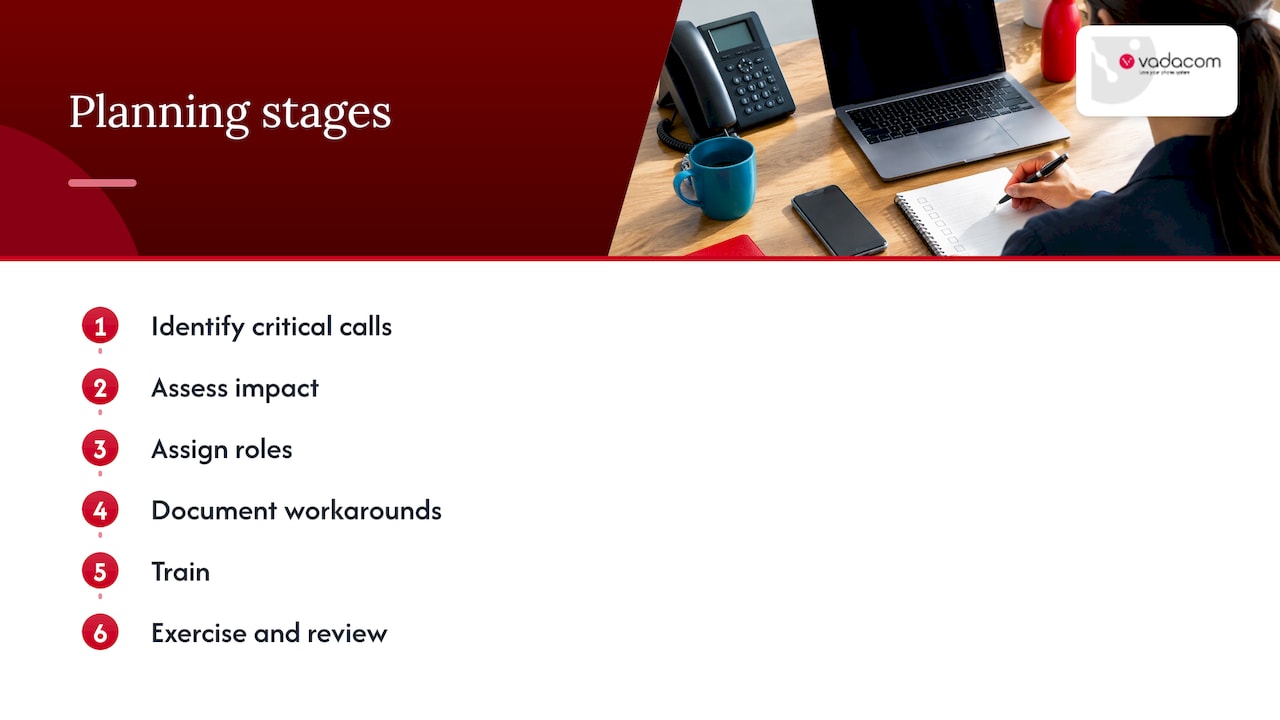
The NACHC manual and Ohio’s 2025 continuity planning guidance follow a similar pattern: identify what matters, assess impact, assign roles, document workarounds, train, exercise, and review. Here is that pattern applied to phones.
1. List the calls you cannot miss
The UK guidance suggests thinking first about what must be communicated, such as sending or receiving a particular piece of information, before choosing technology. For a plumbing business, that might be urgent callouts. For a clinic, appointment changes. For an accounting firm, a client’s deadline-day query. Write down the five or ten call types that cost you money or trust if missed.
2. Map each one to a failure mode
Using the table above, note which disruption would block each call type. A power cut and a flooded office need different responses, so do not collapse them into “the phones are down”.
3. Decide who answers, and where
Assign a named person and a named backup for each call type, as the manual recommends when it asks for leadership roles. Then decide the destination: a mobile, a home desk, a second site or a voicemail box that is monitored.
On NextVoice, individual call-flow management lets you shape how calls are handled, and the platform supports staying connected across the office, home and other work locations on the devices that suit each person. Our guide to call transfer methods covers how transfers and announced transfers work, which matters when a backup person needs to hand a caller on.
4. Pre-build the emergency call flow
The worst time to design a call flow is during an outage. Prepare it in advance:
- A greeting that tells callers what is happening and what to do.
- An alternative route to a mobile or another team.
- Voicemail with a named person who checks it.
- Extension dialling that still works for staff wherever they are.
Because NextVoice lets customers manage users and settings themselves, the person who owns the plan can adjust routing as the situation changes rather than waiting on a ticket. If you want to understand the pitfalls of simple forwarding, our piece on call forwarding to mobile explains when a cloud phone is the better tool.
5. Harden your own edge
This is the layer you own. A short checklist:
- Put the router, switch and any office handsets’ power supply on a UPS.
- Add a second internet path if the phones are mission-critical.
- Keep a spare configured router and a record of its settings.
- Make sure staff can use a softphone or mobile app on their own devices. Our guide to browser-based phones shows how this works for IT teams.
- Check call quality on the backup path, not just the main one. Our five-step VoIP QoS guide helps with that.
6. Train people
A plan nobody remembers is a document, not a plan. Brief staff on where calls go during disruption, how to log in from home, and who to tell. Keep a one-page version printed and stored somewhere that does not depend on the network.
7. Test, record, update
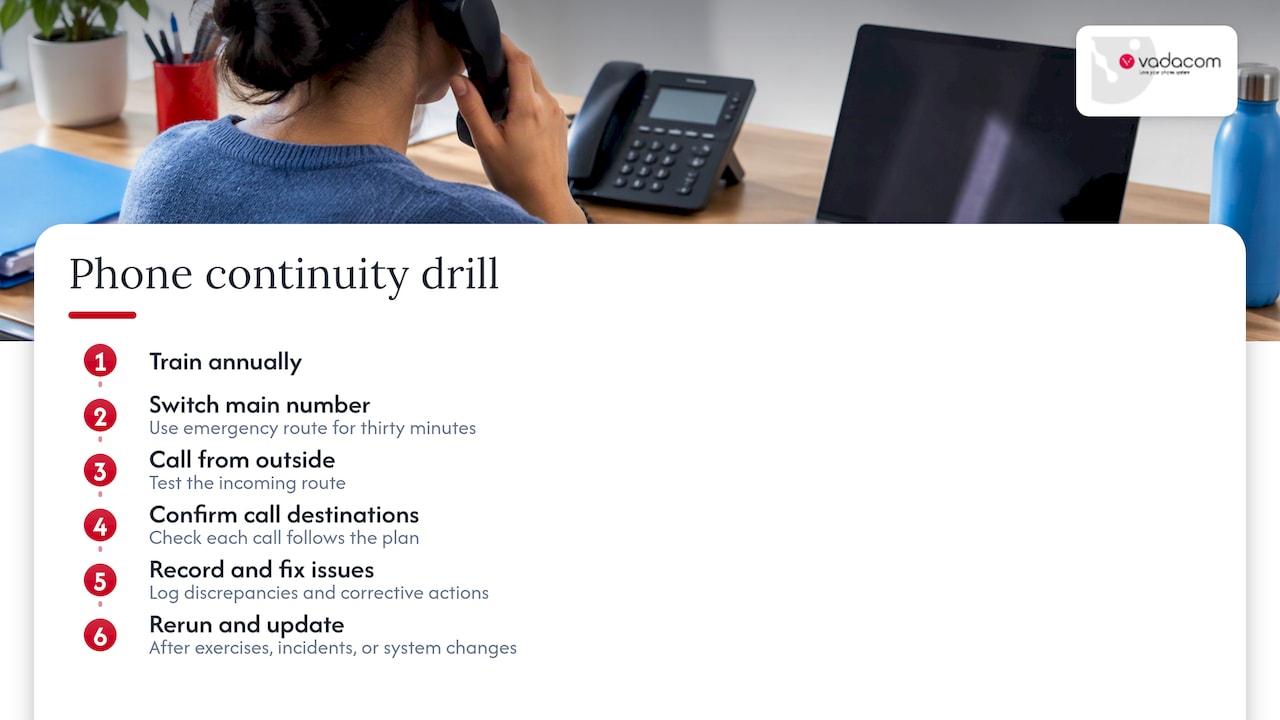
Ohio’s guidance calls for annual training, testing and exercises, recording discrepancies and corrective actions, and updating the plan after exercises, incidents or significant system changes. For phones, a good drill is simple: switch your main number to the emergency route for thirty minutes, have someone ring in from outside, and confirm each call lands where the plan says. For a broader view of how to structure this kind of exercise, see this guide to disaster recovery testing for Australian operations.
Write down what went wrong, fix it, and rerun the drill. Repeat after staff changes, a new office, a new carrier or any change to your call flows.
Keeping staff reachable across sites and remote locations
A continuity phone system should treat location as a setting, not a constraint. Practical arrangements that help:
- One number, many devices. Staff answer the business line on a desk phone, app or browser, so losing the desk does not lose the call.
- Extension dialling across locations. Colleagues at home or at another branch dial the same short extensions they use at work.
- Announced transfer. A backup person can introduce the caller before handing over, so the caller does not have to repeat themselves.
- Voicemail and recording. Messages are captured when nobody is free, and in-app recording lets you review what was said.
If your team is already hybrid, much of your continuity capability exists on a normal Tuesday. Our procurement checks for remote work phone systems set out what to confirm before you commit.
Where AI answering helps, and what to plan around
Many owners reading about continuity are also asking whether an AI receptionist can catch calls when nobody can. It can be a valuable layer: it answers, collects details and routes by rules you define, including outside business hours. Our pages on the AI auto attendant and after-hours phone answering describe how that works with a local team behind it.
Treat it as part of the plan, with its own questions:
- What happens if the AI path is unavailable? Even a public reference project for an AI voice agent on a PBX builds in a fallback to a human receptionist for the case where the AI or its internet link is unavailable. Design your own plan the same way: AI first, then a person, then voicemail.
- What does the uptime number mean? The arithmetic is simple. An annual availability of 99.9% allows about 8.76 hours of downtime a year, while 99.99% allows about 53 minutes. Ask any provider which figure applies to which service, and how it is measured.
- Who governs the routing? Our view is that AI should be introduced through a governed pilot, which we cover in call routing strategies. If you want recording and analysis, AI Call Intelligence is an optional add-on to the platform.
In short, AI widens your options for catching calls. It does not remove the need to decide where a call goes when everything else fails.
The four pillars of continuity planning, applied to phones
You will see “four pillars” mentioned in continuity material, but sources frame them differently, so the useful version is the working cycle. Applied to a phone system it runs like this:
- Identify: which calls and which people are critical.
- Prepare: call flows, devices, a second connection, a cloud platform that is not tied to one building.
- Respond: switch to the emergency route, notify staff and customers.
- Recover and review: restore normal routing, record what happened, update the plan.
That sequence matches the planning, testing and updating loop in the guidance cited above.
Perspective: why we start with the platform
Most continuity conversations we hear begin with a battery or a backup link. Those matter, but they sit at the edge of the problem. The first question is whether your phone system is tied to one room.
We built NextVoice on AWS with multiple availability zones because a business phone system should not be the thing that fails when the office does. Teams can use it across the office, home and other work locations, on the devices that suit them, and customers manage their own users and settings as needs change.
We have spent more than 20 years developing, delivering and supporting communications in New Zealand and Australia, and we keep the feature set focused on what businesses actually use: extension dialling, transfers, voicemail, recording and call flows you control. That focus keeps the system easy to learn, and a system your people know is one they can run under pressure.
Our advice is to settle the platform first, then build the plan around it, then test it every year.
Stuart
Make your phone system part of the plan
If your phones still depend on an on-site system, the quickest way to see where you stand is to review it against the failure modes above. Our technical audit looks at upgrading an older on-premise phone system, and NextVoice and NextMobile are the cloud platform and mobile offer we would move you to. NextVoice is designed to scale with your business and avoids large upfront hardware spend. For a plain-language overview, see our cloud business phone page.

If you also want calls answered when nobody is available, ask us about our locally supported AI answering service via vadacom.com.
FAQ
What is a business continuity phone system?
It is a phone setup designed so calls keep reaching your business during a power cut, internet fault or site loss. In practice that means a cloud-hosted platform, pre-built call-routing rules, a resilient local connection and a plan that staff have rehearsed.
Is a cloud phone system enough on its own?
It removes the on-premise PBX as a single point of failure, but your office still needs power and internet for desk phones. Pair the cloud platform with a UPS, a second connection where calls are critical, and staff able to answer on mobile or app.
How often should we test the plan?
At least once a year, and after any significant change such as a new office, new carrier or revised call flows, in line with Ohio’s continuity planning guidance. A thirty-minute diversion drill is enough to find most gaps.
Can an AI receptionist keep us running during an outage?
It can answer and route calls when staff cannot, provided you plan a fallback for the case where the AI path itself is unavailable. Set the order: AI first, then a named person, then monitored voicemail.
Sources
- Creating a Business Continuity Plan (NACHC)
- 2025 Business Continuity Planning Guidance (Ohio DAS)
- Business continuity planning (Queensland Government)
- Telecoms resilience (GOV.UK)
- Regions and Zones (AWS documentation)
- Business Continuity Planning for VoIP
- Why Top-Tier Business Phone Systems Still Fail During Outages
- AI voice agent PBX reference project (GitHub)
- Disaster Recovery Testing for Australian Operations