

A good receptionist script is short, sounds like a person talking, and gets the caller to one clear next step. Below you’ll find copy-ready examples for the calls a New Zealand business actually gets: the greeting, transfers and holds, taking messages, enquiries, complaints, and calls when you’re closed. Change the bracketed words, read each one aloud, and keep what sounds like you.
TL;DR
- Answer with the business name, your own name and an offer of help. Keep it under about ten seconds.
- Every call should end the same way: confirm what was agreed, say what happens next, thank the caller.
- Tell callers what you can do. Swap “we can’t” for the next step you’ll take.
- Write scripts as prompts, not speeches. Staff who sound read-out lose the caller’s trust.
- The same wording should work on the front desk, on voicemail and in your auto attendant, so callers hear one voice.
Table of Contents
- What a good phone script does
- Greeting scripts
- Transfer and hold scripts
- Taking a message
- Enquiry scripts
- Complaint and difficult-call scripts
- After-hours and voicemail scripts
- Closing a call
- Making scripts sound natural
- Our perspective: scripts only work if the phone system supports them
- Where Vadacom fits
- FAQ
- Sources
What a good phone script does
A script isn’t there to make people sound identical. It’s there so the basics happen on every call, whoever picks up and wherever they’re working: the caller knows they’ve reached the right place, feels heard, and leaves knowing what happens next.
New Zealand’s qualifications body sets out what it expects of someone answering enquiries by phone. NZQA unit standard 11815 says a call should be answered and greeted with a consistent welcome message, a cheerful tone, a positive attitude, courtesy and timeliness. That list is a useful test for any script you write: is it consistent, warm, polite and prompt?
Four habits sit behind every example in this article:
- Start with the caller’s need. Skip the long company slogan.
- Use spoken language. If you wouldn’t say it to a customer across a counter, rewrite it.
- Offer one next step. “I’ll transfer you now” beats a menu of options.
- Close the loop. Repeat back what you’ve agreed so nothing is left to memory.
Greeting scripts
The greeting carries the most weight and takes the least time. It needs three things: who they’ve reached, who is speaking, and an invitation to talk.
Standard greeting
“Good morning, Harbour Plumbing, Sam speaking. How can I help?”
When the caller is likely to be in a hurry (trades, logistics, clinics)
“Harbour Plumbing, Sam here. What can I do for you?”
Department line
“Good afternoon, Accounts at Harbour Plumbing, this is Aroha. How can I help?”
Answering a direct line or mobile that rings through to your business
“Harbour Plumbing, Sam speaking. Thanks for calling.”
Busy period, when the caller may have waited
“Thanks for holding, you’ve reached Harbour Plumbing. Sam speaking, how can I help?”
A few notes on delivery. Smile before you pick up, because tone carries on the phone. Say your name slowly enough to be caught. Avoid “Hello?” alone, which leaves the caller unsure they’ve dialled correctly. Use a Kiwi-natural “Kia ora” only if it’s how your team really speaks and your callers expect it; a forced greeting sounds worse than a plain one.
If your team works from home or on mobiles, the greeting has to be identical wherever the call lands. With a cloud phone system such as NextVoice, calls reach staff on whichever device suits their working style, so agreeing one greeting matters more, not less.
Transfer and hold scripts
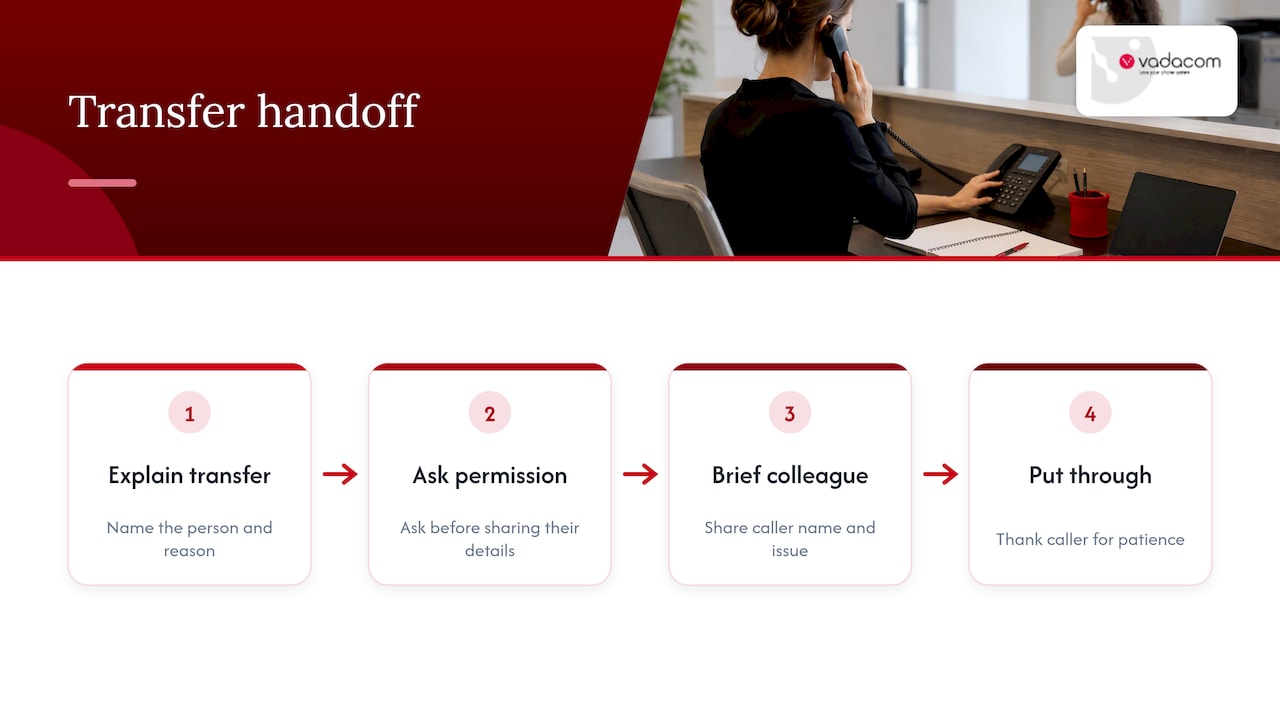
Most frustration on business calls comes from being passed around. The fix is to explain, ask permission, and make sure the next person knows who’s coming.
Asking to place on hold
“I’ll just check that for you. Do you mind holding for about a minute?”
Wait for the answer. Then, if the check takes longer than you said:
“Thanks for waiting. I’m still looking into it. Would you like to keep holding, or shall I call you back within ten minutes?”
Announced (attended) transfer
Speak to the caller first:
“Priya in our service team looks after warranty claims. I’ll introduce you now. Can I tell her your name and what it’s about?”
Then to your colleague, with the caller on hold:
“Priya, I have Mr Wiremu Tane on the line about a warranty claim on a heat pump installed in March. Can you take him?”
Then to the caller:
“Putting you through now. Thanks for your patience, Mr Tane.”
When the colleague isn’t available
“Priya’s on another call at the moment. I can put you through to her voicemail, take a message, or arrange a call back. Which would suit you best?”
The announced version takes thirty extra seconds but saves the caller repeating their story. If you want to understand when a blind transfer is the better tool and when it isn’t, our note on attended versus blind transfers covers how the two behave on a phone system.
Redirecting a call that’s outside your area
Avoid “That’s not my department.” Mailchimp suggests a positive alternative along the lines of: “To ensure you receive the most accurate information, I’ll gladly transfer you to our expert in that area.” Shorten it for real use:
“The best person for that is Jo in purchasing. Let me put you through so you get the right answer.”
Taking a message
A message is a promise. The NZQA standard points to recording the date, the enquiry, the action taken and the follow-up, and it expects a receptionist to refer matters outside their responsibility or capability. Turn that into a short routine.
Script
“Mere isn’t available right now. I can take a message and make sure she gets it today. Can I have your name and the best number to reach you?”
“And what’s it regarding?”
“Is there a time that suits you for a call back?”
“Let me read that back: you’re Dan Ellis, on 021 555 0123, calling about the quote for the Takapuna job, and you’d like a call after two this afternoon. I’ll pass that on straight away. Thanks, Dan.”
Message record template
| Field | What to capture |
|---|---|
| Date and time | When the call came in |
| Caller | Full name, company |
| Number | Best number, plus alternative if needed |
| Reason | One sentence, in the caller’s words |
| Urgency | Same day, this week, no rush |
| Action | Who will do what, by when |
| Follow-up | Who checks it happened |
The follow-up row is the one most businesses skip, and it’s the one that stops callers feeling ignored. If your phone system emails voicemail straight to the right inbox, the loop closes faster; see voicemail to email setup for how that works with local support.
Enquiry scripts
Enquiries are where a script earns revenue. The aim is to understand what the caller needs, answer or route it, and leave them with a clear next step.
General enquiry
“Happy to help. Can you tell me a bit about what you’re looking for?”
(Listen. Then paraphrase.) “So you need a quote for repainting a two-storey house in Hamilton before Christmas. Is that right?”
“Our estimator, Tom, can visit this week. Would Thursday morning or Friday afternoon suit?”
NZQA’s standard lists active listening techniques that fit here: giving full attention, asking open and closed questions, clarifying, reflecting, paraphrasing, summarising and even using purposeful silence. Open questions get the story (“What’s happening with it?”). Closed questions fix the detail (“Is it the front door or the back?”).
Price enquiry
“Good question. Prices depend on the size and the work involved, so I don’t want to guess. I can get you an accurate figure today if I take a few details. What’s the address?”
Hours, location and directions
“We’re at 14 Quay Street, open Monday to Friday, eight to five. There’s customer parking out the back. Would you like me to text you the address?”
Technical support enquiry
If your front desk fields IT or product questions, the script is about sorting the issue before routing it:
“I’m sorry that’s playing up. Is it affecting just you, or others in the office as well? And has anything changed recently, like an update?”
“Thanks. I’ll pass that to our support team with those details so you don’t have to repeat yourself. Someone will call you within the hour.”
That structure, listen, clarify, then direct to the right team, is what a good help desk service does for small businesses, and a front-desk script can borrow it. Only promise a time window you can meet.
Complaint and difficult-call scripts
With an upset caller, the first job isn’t solving the problem. It’s making them feel heard. NZQA’s standard on challenging customers describes the sequence: identify the caller’s emotion, ask open questions to clarify the issue, and check whether a translator is needed. It then moves to working out possible resolutions, confirming the caller understands the proposed resolution or escalating within your authority, recording the complaint and resolution, and following up.
Step 1: acknowledge
“I can hear this has been really frustrating, and I’m sorry. Let me make sure I understand what’s happened.”
Step 2: clarify with an open question
“Can you walk me through what happened from the start?”
Step 3: positive, solution-focused wording
Shopify New Zealand describes positive scripting as affirmative, solution-focused language, and recommends replacing limits like “we can’t” with a clear explanation of how you can help. Its example is close to this: “I’m so sorry for the inconvenience, let me check on that and find a solution.”
| Instead of | Try |
|---|---|
| “We can’t do that.” | “What I can do is arrange X by Friday.” |
| “You’ll have to ring back.” | “I’ll have Sam call you this afternoon.” |
| “That’s company policy.” | “Here’s how that works, and here’s what we can offer.” |
| “I don’t know.” | “Let me find out and come back to you by 3 pm.” |
| “Calm down.” | “I want to get this sorted for you.” |
Step 4: confirm or escalate
“So I’ll arrange a replacement to go out on Wednesday, and you’ll get a text when it’s on its way. Does that work for you?”
Or, when it’s beyond your authority:
“This needs a decision from our manager, Hemi. I’ll brief him now so you don’t have to explain it again, and he’ll call you by 4 pm today.”
That matches how callers are advised to approach complaints. New Zealand’s Consumer Protection site tells customers to ask for the person who can resolve the issue, stick to facts and say what outcome they want. Your script should make that easy: get to someone with authority quickly, and ask the caller what a good outcome looks like.
Callers who need extra help
The same Consumer Protection page notes that deaf, hard-of-hearing, speech-impaired and deafblind people can use the free New Zealand Relay Service to contact businesses by phone. If a relay call comes in, expect more pauses and a relay assistant speaking for the caller. Don’t hurry it and don’t address the assistant as the customer. Useful lines:
“Take your time, I’m happy to wait.”
“Would it help if I repeat that more slowly, or send the details in writing?”
NZQA’s newer customer-service standard, 40045, treats adaptability and inclusivity as core skills: adjust to different needs while staying professional and protecting confidentiality.
Complaints often start as unanswered questions. If the same ones keep arriving, it’s worth writing FAQs from customer data rather than guesswork, so you fix the cause as well as the call.
After-hours and voicemail scripts
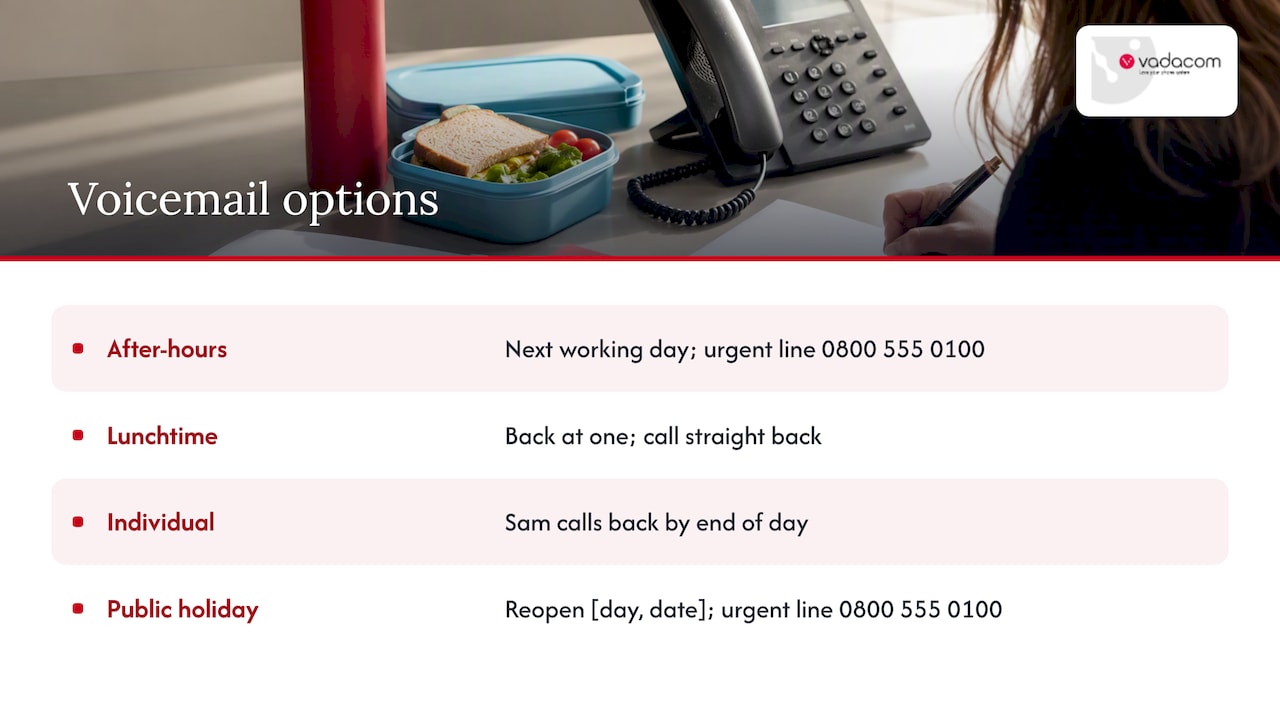
When no one can answer, the recorded message is your receptionist. It should say who you are, that you’re closed or unavailable, what the caller should do next, and how to reach someone if it’s urgent. Shopify New Zealand’s voicemail guidance lists much the same: identify the company, state availability or hours, ask for name, message and callback number, and give alternative contact details where relevant.
After-hours greeting (about 20 seconds)
“Kia ora, you’ve reached Harbour Plumbing. Our office is open Monday to Friday, eight to five. We’re closed right now, but we’ll return your call first thing next working day. Please leave your name, number and what it’s about. If it’s an emergency, call our after-hours line on 0800 555 0100.”
Lunchtime or short absence
“You’ve reached Harbour Plumbing. We’re away from the phones until one o’clock. Leave your name and number, and we’ll call you straight back.”
Individual voicemail
“Hi, you’ve reached Sam Taylor at Harbour Plumbing. I can’t take your call right now. Leave your name, number and a short message and I’ll call you back by the end of the day.”
Public holiday
“We’re closed for the public holiday and will reopen on [day, date]. For urgent plumbing emergencies, call 0800 555 0100. Otherwise leave a message and we’ll ring you when we’re back.”
Never promise a call back time you can’t keep. “First thing next working day” is safer than “within the hour”. We have ready-made wording for this in our voicemail greeting examples, including 10 to 30 second versions and recording tips, and for a deeper look at covering evenings and weekends, see after-hours phone answering.
Auto attendant prompts
If you use a menu before the call reaches a person, keep it to a few options and put the most common first:
“Thanks for calling Harbour Plumbing. For a new quote, press 1. For an existing job, press 2. For accounts, press 3. To speak to someone, stay on the line.”
Our auto attendant scripts page has more you can copy, and call flow design explains how to map calls before you build the menu.
Closing a call
A clean close is a habit worth drilling, because it’s what the caller remembers. NZQA says a close can include confirming the agreement, giving a farewell, using the customer’s name, thanking the customer and stating the next course of action. Put those together:
“So, Dan, I’ll book the estimator for Thursday at 9 am and send a confirmation text today. Is there anything else I can help with? Thanks for calling Harbour Plumbing, have a great day.”
The order matters: agreement, next step, anything else, thanks, goodbye. Let the caller hang up first where you can.
Making scripts sound natural
The fastest way to ruin a good script is to read it word for word. Treat it as a skeleton.
- Say it aloud before you adopt it. If you stumble, the caller will too. Written phrases like “I shall endeavour to” fail this test immediately.
- Keep sentences short. OHVO, a New Zealand on-hold and greeting specialist, advises that a script should sound natural aloud, start with the caller’s need, stay short and give the caller one useful next step.
- Vary your openers. Staff can personalise the middle of a call but should keep the greeting and close consistent.
- Use the caller’s name once or twice, not in every sentence.
- Reflect before you answer. “So the courier left it at the wrong address” shows you were listening and catches misunderstandings early.
- Allow silence. A pause after a complaint is often better than an instant reply.
Role-play for ten minutes in a team meeting. Have one person play a frustrated caller and another the receptionist, then swap. Record what felt awkward and rewrite those lines. Review the scripts every few months, because your products, hours and common questions will shift.
Our perspective: scripts only work if the phone system supports them
We’ve spent more than 20 years designing, delivering and supporting business communications for New Zealand and Australian businesses, and the pattern is consistent. A well-written script often fails not because staff ignore it, but because the technology gets in the way. A call lands on the wrong device, a transfer drops the caller, voicemail goes to an inbox nobody checks, or the after-hours message still says last year’s hours.
So we suggest writing the script and the call flow together. Decide who answers first, where each type of call goes, what happens when that person is busy, and what the caller hears when nobody is available. Then set the phone system to match. With NextVoice, teams can use extension dialling, call transfer and announced transfer, voicemail and individual call-flow management from the office, home or other locations, and administrators can change users and settings as the business changes, without on-premise hardware.
We also think AI has a place, but with care. An AI answering service can cover the calls humans can’t reach, using the same greetings and escalation rules you’d train a person on. The rules still have to come from you: what it may say, what it must hand to a person, and how a caller reaches one. Start with the scripts in this article, test them with people, and only then decide what to automate.
— Stuart
Where Vadacom fits
If your scripts are ready but your phone system makes them hard to follow, NextVoice is our cloud business phone system, built on AWS and supported locally. If you’d like to know how an old on-premise system compares with what you need, our technical audit is a practical place to start. And if missed calls are your main problem, ask us about our AI answering service, which can work alongside your team. Results depend on your setup and call volumes, so we’ll talk through your own situation first.
FAQ
What is a good script for answering a business phone call?
Say the business name, your name, and an offer of help: “Good morning, Harbour Plumbing, Sam speaking. How can I help?” Keep it consistent across your team, smile as you pick up, and listen before you answer. End with a confirmed next step and a thank you.
How should I answer the phone if I’m busy?
Still give the full greeting, then ask permission before holding: “Do you mind holding for a moment?” Wait for a yes. If you can’t help soon, offer a call back at a specific time rather than leaving them waiting.
Should receptionists read from a script word for word?
No. Use scripts for the greeting, the close and tricky situations like complaints, and let staff speak naturally in between. Practise aloud so the wording becomes your own, and update it when your services or hours change.
What do I say when a caller is angry?
Acknowledge the feeling first: “I can hear this has been frustrating, and I’m sorry.” Ask an open question to understand what happened, then explain what you can do. If the fix needs someone with more authority, introduce the caller to that person and say when they’ll hear back.
Sources
- NZQA unit standard 11815: Answer customer enquiries on the telephone
- NZQA unit standard 28268
- NZQA 40045: Apply customer service techniques
- Consumer Protection: Contacting the business with a complaint
- Mailchimp: Positive scripting techniques
- Shopify NZ: Positive scripting for customer service
- Shopify NZ: Business voicemail greeting best practices
- Write effective FAQs from customer data
- What is a help desk service? A guide for SMBs